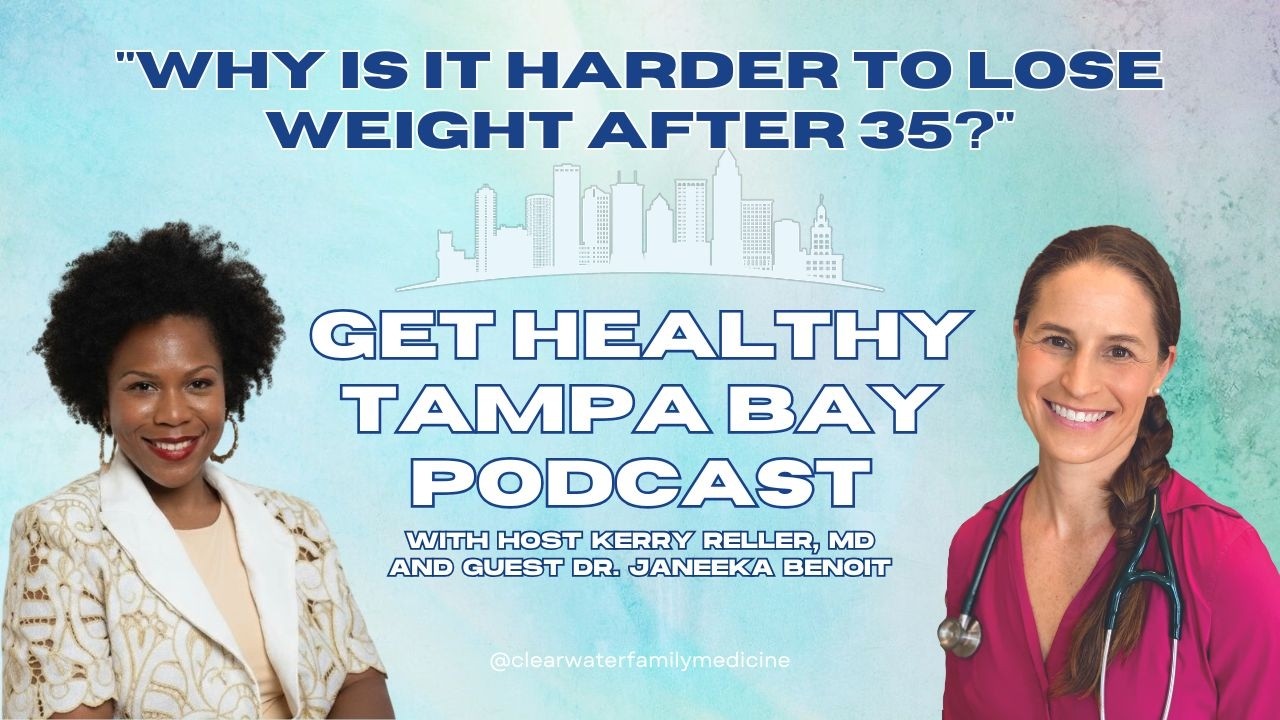
Why Weight Loss Gets Harder After 35 with Dr. Janeeka Benoit
"I'm doing all the same things, so why can't I lose weight anymore?" If you are a woman in your mid-30s or beyond, you may have asked this yourself. In this episode of the Get Healthy Tampa Bay Podcast, Dr. Kerry Reller talks with Dr. Janeeka Benoit, a double board-certified internal medicine and sports medicine physician and founder of the telehealth practice Invessel Health and Wellness, about why weight loss gets harder with age and what actually helps.
A Doctor Who Has Been There
In her mid-30s, Dr. Benoit gained weight quickly after surgery and found it much harder to lose than when she was younger. Her LDL cholesterol rose for the first time, and with a family history of heart disease, she knew she had to act. That experience shaped her practice, which helps busy, high-achieving women lose weight and prevent chronic disease. The name Invessel means "invest in your vessel," inspired by the osteopathic idea that each person is made of mind, body and spirit.
Two Kinds of Aging
Chronological aging: Starting around age 30, we lose about 3% to 8% of our muscle mass per decade. Less muscle means a slower metabolism.
Ovarian aging: As estrogen declines in perimenopause and menopause, the body tends to store more fat around the belly, heart, liver and muscles. This visceral fat is inflammatory and can lead to insulin resistance.
Together, these changes can set the stage for metabolic syndrome, a cluster of problems including high blood sugar, high cholesterol, high blood pressure and a larger waist, which raises the risk of heart attack, stroke and type 2 diabetes. Dr. Benoit compares a healthy body to a well-run factory, and metabolic syndrome to a factory in chaos.
Why Muscle Matters So Much
Muscle acts like a sponge for blood sugar, soaking it up without needing as much insulin. It also burns more energy at rest. Dr. Benoit compares it to a mansion that takes more energy to maintain than a one-bedroom apartment. That is why tracking body composition, not just weight, is key: the goal is lower body fat and visceral fat while keeping or building muscle.
Key Takeaways
Challenge your muscles: Doing the same workout for years without progression will not give the same results. Dr. Benoit focuses on strength (heavy loads around 80% of your one-rep max), power (moving a moderate load quickly) and muscle growth (at least 10 sets per muscle group each week).
Move more throughout the day: Working from home and spending more time on screens makes us more sedentary than we realize. Park farther away, take the stairs and walk to nearby errands.
Get creative: Face a walking pad toward a window, do five squats (or "butt taps") before sitting in your desk chair, try wall push-ups, or add a few lunges during a walk.
Look at sleep and stress: High cortisol from chronic stress or poor sleep disrupts deep sleep, makes insulin work less well and increases hunger hormones. Undiagnosed sleep apnea, which is common in midlife women, can be part of the cycle.
Fuel properly: Exercising hard without enough nutrition will not give you the results you want, and overtraining can raise stress hormones.
Get a full evaluation: Dr. Benoit reviews mood, sleep, exercise, labs such as LDL cholesterol, fasting glucose and A1C, and family history to find the main factors holding someone back.
Mindset: Consistency Over Perfection
High achievers often fall into all-or-nothing thinking: miss one workout and the whole week is "ruined." Dr. Benoit asks every patient for their health win of the week, because many overlook what they did do, such as two gym sessions or hitting their protein goals. She also helps patients let go of food guilt. If you want cake on your birthday, enjoy a slice you truly love, after a satisfying meal. Look at restaurant menus ahead of time, share dishes, and pause to ask whether you are hungry or craving something because of stress.
Conclusion
Weight gain in your 30s, 40s and beyond is not a personal failure. It reflects real changes in muscle, hormones, sleep and stress. Focus on building and challenging your muscles, moving more during the day, protecting your sleep, managing stress and celebrating small wins. Progress comes from consistency, not perfection.
About Our Guest
Dr. Janeeka Benoit is a Double Board-Certified Internist & Sports Medicine physician and the founder of Invessel Health & Wellness.
She helps high-achieving women achieve sustainable weight loss to lower their risk of chronic disease and live longer, healthier lives.
Her approach is grounded in both clinical expertise and personal experience. Despite leading an active lifestyle, she experienced unexpected weight gain and rising cholesterol, revealing the gap between conventional weight loss advice and true metabolic health.
Today, Dr. Janeeka's mission centers on helping women achieve Less Weight. Less Risk. More Years so they can spend more of life healthy, active, and strong.
Connect with Dr. Janeeka Benoit
Listen to the full episode on the Get Healthy Tampa Bay Podcast: Why Weight Loss Gets Harder After 35 with Dr. Janeeka Benoit
Listen and Learn More
Watch the full episode above or listen to the Get Healthy Tampa Bay Podcast on your favorite podcast app. To schedule a visit with Dr. Kerry Reller at Clearwater Family Medicine and Allergy in Clearwater or Palm Harbor, call (727) 446-1097.


