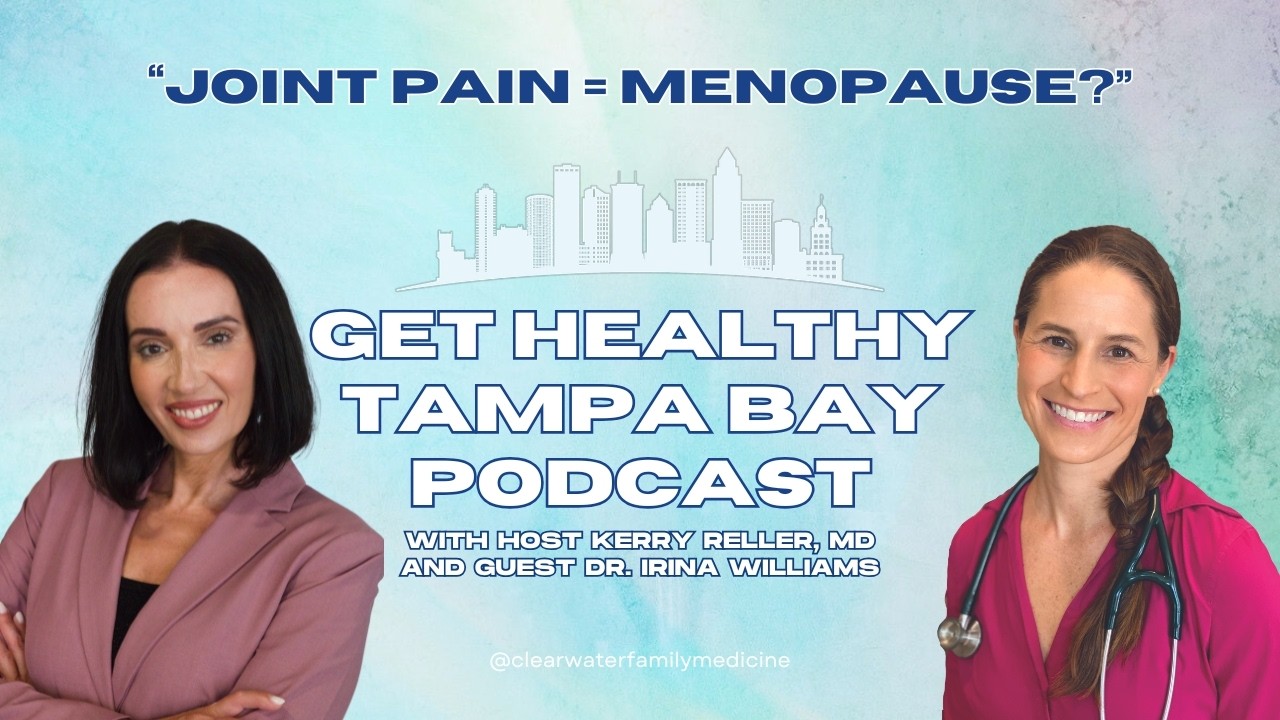
Why Does Everything Hurt? Menopause & Chronic Pain with Dr. Irina Williams
Achy joints, a frozen shoulder, plantar fasciitis or tennis elbow that seems to come out of nowhere in your 40s may not just be "getting older." In this episode of the Get Healthy Tampa Bay Podcast, Dr. Kerry Reller talks with Dr. Irina Williams, a board-certified pain medicine physician, anesthesiologist and menopause specialist, about the link between chronic pain and the menopause transition, and how to treat it before it becomes harder to fix.
Pain and Menopause Are Connected
After years of treating women with complex chronic pain, Dr. Williams kept seeing the same pattern. A woman in her 50s would say her pain started in her late 30s or mid-40s, even though nothing in her life had changed. Pain care and menopause care have historically been treated separately, leaving women bouncing between specialists. She founded the Women's Pain Institute, a telehealth-first practice licensed in all 50 states, so women can get both in one place.
What Is the Musculoskeletal Syndrome of Menopause?
Dr. Williams says more than 80% of women in the menopause transition experience pain. Orthopedic surgeon Dr. Vonda Wright and colleagues named this pattern the musculoskeletal syndrome of menopause. Bones, joints, muscles and tendons all have estrogen receptors, and estrogen helps calm inflammation. As estrogen drops, these tissues become less resilient and more prone to inflammation, so the same activity can produce a very different response. Common examples include:
Frozen shoulder and plantar fasciitis
Tennis elbow and other tendon problems
Muscle knots, tightness and trigger points (myofascial pain)
New back or neck pain
Bone loss leading to osteopenia or osteoporosis
Key Takeaways
Get unexplained pain checked early: Any new pain between about ages 35 and 55 is worth evaluating, since perimenopause can start as early as the 30s.
Chronic pain changes the brain: After about six to twelve months of ongoing pain, the nervous system can get "stuck" in a sensitized state, making pain spread and become harder to treat.
Hormone therapy helps, but is not a cure-all: Many women start hormone therapy hoping it will fix their joint pain. It can help, but a full evaluation is needed to tell hormonal pain from structural problems.
Women's pain changes through the cycle: Women are least sensitive to pain around days 5 to 14 of the menstrual cycle, when estrogen and testosterone are highest, so that is the best time for something uncomfortable.
Blood sugar affects pain: When blood sugar spikes, pain tends to spike too. A continuous glucose monitor can reveal patterns, including nighttime drops that disrupt sleep.
Do not forget the pelvic floor: Pregnancy and perimenopause both weaken the pelvic floor, which can be a hidden cause of back pain when an MRI looks normal.
How Dr. Williams Evaluates and Treats Pain
She starts with a detailed pain history and physical exam, then may use in-office ultrasound, imaging, inflammatory markers and a look at metabolic health and stress. Blood hormone levels are not very reliable in perimenopause because they fluctuate, so she uses them only as one piece of the picture. Treatment happens on several fronts at once:
Exercise, starting small: Strength training is the goal, but women in pain often need to build up slowly with body weight and light dumbbells, which she prefers over resistance bands. Working a tight muscle, such as rows for knots between the shoulder blades, can teach it to relax and contract properly.
Physical therapy and pain control: Medications, supplements and better sleep may be needed first so women can move without being out of commission for days afterward.
Hormone therapy: For women in perimenopause or menopause, she considers it alongside the rest of the workup rather than waiting.
GLP-1 medications: For the right patient, these can help with weight and inflammation.
Injections: She increasingly prefers regenerative options like PRP over steroid shots for younger women, since steroids can affect bone and blood sugar.
A Story About Steroids
Dr. Williams shared a patient in her 30s with jaw pain (TMJ) who was started on metformin for rising blood sugar despite a healthy weight. Looking back, Dr. Williams realized the patient had been getting steroid injections every three months. She switched the patient to Botox injections instead, and eight months later the blood sugar improved and the metformin was stopped. Both doctors agree that steroids have their place, but repeated doses deserve careful tracking, especially in midlife women losing bone density.
Conclusion
Joint and muscle pain in midlife is not always just aging or an old injury. Hormonal changes may be one piece of the puzzle. If you are between 35 and 55 and dealing with new, unexplained pain, talk with your doctor early, before the pain becomes chronic and harder to treat.
About Our Guest
Dr. Irina Williams, MD, MHA, is a board-certified Pain Medicine physician and an anesthesiologist with more than a decade of clinical and executive leadership in healthcare. She developed and launched the Interdisciplinary Chronic Pain clinic in Alameda Health System and led this program for over 6 years. Separately, she is also the founder of an AI healthcare company.
Dr. Williams founded The Women's Pain Institute to build an institution that focuses on comprehensive, evidence-based care that addresses the relationship between chronic pain, menopause, metabolic health, aging, and whole-person wellness, helping women in midlife manage pain and menopause without having to see multiple specialists, to reclaim their vitality, mobility, and quality of life after being told, one too many times, that nothing is wrong.
She writes and speaks on chronic pain in midlife, menopause, healthy aging, women's health, and physician leadership.
Connect with Dr. Irina Williams
Listen to the full episode on the Get Healthy Tampa Bay Podcast: Why Does Everything Hurt? Menopause & Chronic Pain with Dr. Irina Williams
Listen and Learn More
Watch the full episode above or listen to the Get Healthy Tampa Bay Podcast on your favorite podcast app. To schedule a visit with Dr. Kerry Reller at Clearwater Family Medicine and Allergy in Clearwater or Palm Harbor, call (727) 446-1097.


