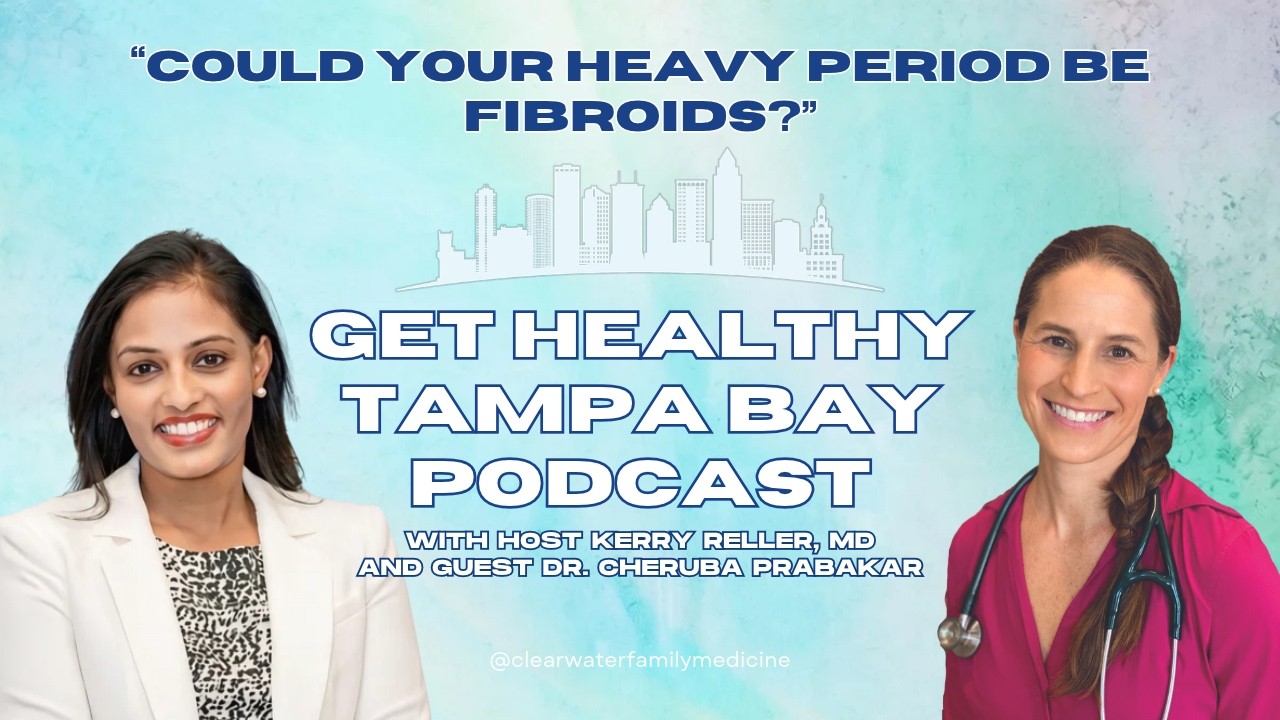
Understanding Fibroids and Treatment Options with Dr. Cheruba Prabakar
Heavy periods are so common that many women assume they are normal. In this episode of the Get Healthy Tampa Bay Podcast, Dr. Kerry Reller talks with Dr. Cheruba Prabakar, an OB-GYN and minimally invasive surgeon known online as The Fibroid Doc, about why uterine fibroids are often missed, how they are diagnosed, and the full range of treatment options beyond hysterectomy.
Fibroids Are More Common Than You Think
By age 50, about 80% of women will be diagnosed with a fibroid. Fibroids are benign (noncancerous) growths of the smooth muscle of the uterus, and they can start as early as your 20s. Dr. Prabakar sees a peak from the mid-30s to late 40s, when fibroids can also grow quickly. Many women never have symptoms. Others live with heavy bleeding for years because they think "this is just how periods are."
Key Takeaways
Heavy bleeding is not normal: Soaking a pad or tampon every hour, feeling lightheaded or dizzy, or missing school, work or plans because of your period are signs that something may be wrong.
Fatigue and iron deficiency can be a clue: Dr. Reller often sees tired patients with low iron, and heavy periods are a common cause. Fibroids are one reason to look for.
A pelvic ultrasound is the first test: It takes 15 to 20 minutes and uses no radiation. An MRI may be added later if surgery is being considered.
Do not assume it is "just perimenopause": Irregular or heavy bleeding in your 40s deserves a workup, usually an ultrasound and sometimes a biopsy, before it is blamed on perimenopause.
Fibroids can affect fertility and pregnancy: Fibroids inside the uterine cavity can block implantation and lead to miscarriage. During pregnancy, fibroids can grow or lose their blood supply and cause severe pain.
Endometriosis and adenomyosis can look similar: These conditions often appear alongside fibroids, and it takes women an average of four to seven years to get a diagnosis.
Hysterectomy is not the only option: Treatment depends on your symptoms and goals.
Treatment Options, Step by Step
Watch and wait: Fibroids that cause no symptoms can simply be checked with a scan every few years.
Hormonal medications: These can reduce heavy bleeding, although they do not remove the fibroid.
Embolization or ablation: These procedures cut off the blood supply to fibroids so they shrink over time, which can take up to a year.
Myomectomy: Surgery to remove the fibroids while keeping the uterus, often the choice for women who want to get pregnant.
Hysterectomy: The final option for women who are done having children and want long-term relief.
Dr. Prabakar encourages anyone told they need a hysterectomy to get a second or even third opinion. Removing the uterus is major surgery, and studies suggest it may lead to menopause about a year earlier and a higher risk of heart disease, even when the ovaries are kept. For women whose quality of life is suffering, though, it can be the right choice.
Conclusion
Fibroids affect millions of women, yet many go undiagnosed for years. The most important message from this episode: be proactive. If your periods are heavy, painful or interfering with your life, ask for a pelvic ultrasound and keep asking questions until you get answers. For a complete guide to your options, Dr. Prabakar's new book, Fibroids: Finally Heard, is a great next step.
Dr. Prabakar's Book: Fibroids: Finally Heard
Dr. Prabakar wrote Fibroids: Finally Heard: A Practical Guidebook from Diagnosis to Recovery because so many patients were arriving with scattered information from Instagram and TikTok and little time with their doctors. The book walks you through everything covered in this episode, including her mother's story, how to get the care you deserve, fertility and treatment options, surgical considerations, and how to prepare for and recover from treatment. It includes helpful checklists and takes about 90 minutes to two hours to read. It also links to The Fibroid Circle, her online community with a monthly live Q&A.
Get Fibroids: Finally Heard on Amazon (paperback and Kindle).
About Our Guest
Dr. Cheruba Prabakar is a board-certified OB-GYN and fellowship-trained minimally invasive surgeon. She founded Lamorinda Gynecology & Surgery in Northern California in 2022, a boutique practice focused on complex gynecology, including fibroids, endometriosis, menopause and sexual medicine. Known on social media as @thefibroiddoc, she is the author of Fibroids: Finally Heard (2026).
Connect with Dr. Cheruba Prabakar
Listen to the full episode on the Get Healthy Tampa Bay Podcast: Understanding Fibroids and Treatment Options with Dr. Cheruba Prabakar
Listen and Learn More
Watch the full episode above or listen to the Get Healthy Tampa Bay Podcast on your favorite podcast app. To schedule a visit with Dr. Kerry Reller at Clearwater Family Medicine and Allergy in Clearwater or Palm Harbor, call (727) 446-1097.


