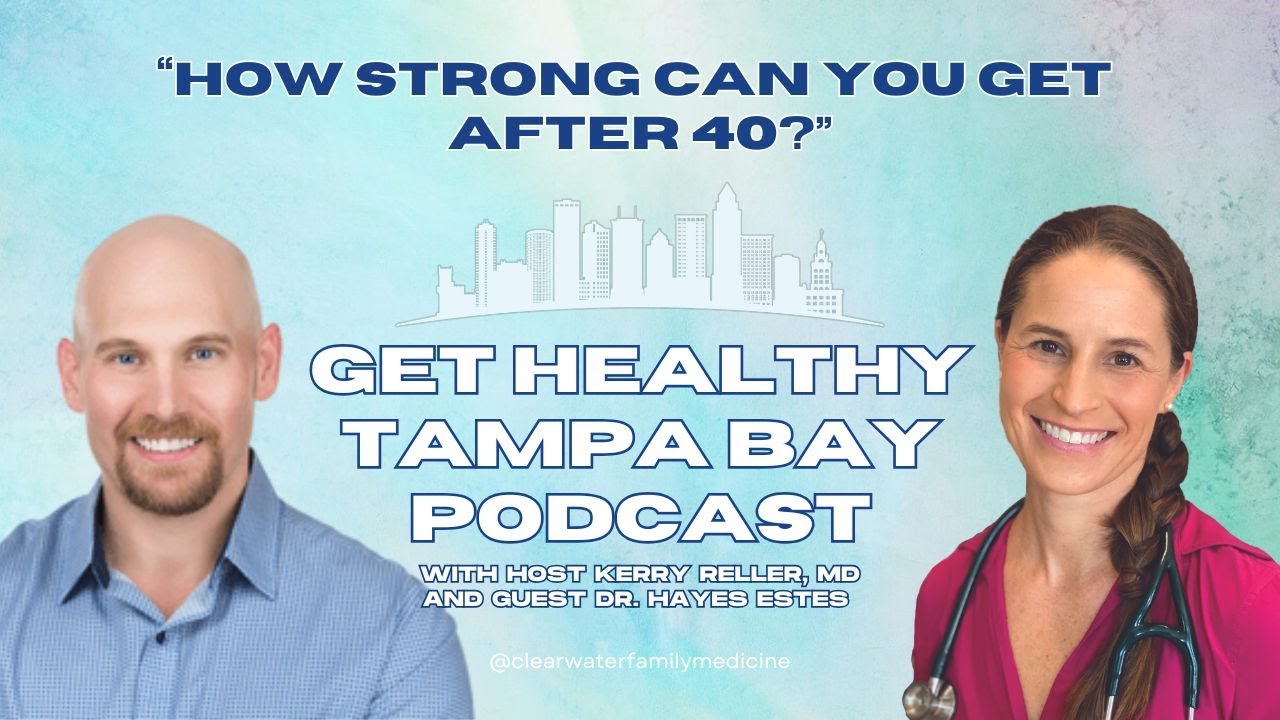
Training Smart as You Age with Dr. Hayes Estes: Strength, Longevity & Recovery
You do not have to be a competitive athlete to train like one. In this episode of the Get Healthy Tampa Bay Podcast, Dr. Kerry Reller welcomes back Dr. Hayes Estes, a doctor of physical therapy, board-certified orthopedic clinical specialist and owner of Premier Physical Therapy in Clearwater and Tarpon Springs, to talk about how to stay strong and active as you age, at any age and any fitness level.
Invest in Your Health Like Your Retirement
Dr. Estes says about 77% of Americans do not meet the minimum recommended exercise guidelines, which help protect against diabetes, high blood pressure, some cancers and other chronic conditions. He compares exercise to a retirement account: the earlier you invest, the more you will enjoy your later years. But it is never too late to start. Studies show that even people in their 90s who begin strength training can build strength and muscle. Dr. Reller adds that muscle mass naturally declines with age, which affects balance, fall risk and the ability to recover from injuries.
What the Exercise Guidelines Really Say
Many people feel overwhelmed because they think they need to work out every day. The guidelines are simpler:
Cardio: 150 minutes of moderate-intensity activity or 75 minutes of vigorous activity per week.
Strength: Two days of moderate-intensity strength training per week.
Exercising three to four days a week can easily meet both goals. If you are just getting started, a 10 to 15 minute walk around the block is a great first step.
How to Measure "Moderate Intensity"
Intensity is personal. Dr. Estes uses a method called "reps in reserve." At the end of a set, ask yourself how many more repetitions you could have done. Stopping with about two or three reps left in the tank is a good moderate intensity for building strength. That might be 5 sit-to-stands from a chair one day and 10 the next. Over time, doing a little more, called progressive overload, makes you stronger.
Key Takeaways
Train the fundamental movements: Squat, hinge (bending to pick something up), lunge, push, pull and carry. These are the movements of daily life.
A chair is a great starting point: Sitting down and standing up is a squat, and it helps with getting on and off the toilet or out of a car.
No movement is inherently dangerous: Problems usually come from doing too much, too soon or too fast. Squatting with your knees over your toes is normal, and you do it every time you walk down stairs.
Grip strength matters: Weaker grip strength is linked with higher mortality, and it affects everyday function.
Recovery changes with age: After 40, lower testosterone and growth hormone mean slower recovery, so save your all-out efforts for select workouts.
Cover the basics first: Good sleep and nutrition support recovery and progress.
Strength Training Builds Confidence
Strength training improves bone density, balance and fall prevention, which matters because hip and leg fractures after age 80 carry a high risk of death. It also builds confidence. One of Dr. Estes's patients was so afraid of falling after a knee replacement that she stopped going to Zumba and her classes at the YMCA. His team worked on lunges and eventually practiced getting up from the floor. When she stood up on her own, the look on her face said it all, and she returned to the activities she loved.
Physical Therapy and Medicare
Dr. Reller is considering offering physical therapy referrals to more patients at their Medicare annual wellness visits to help with strength, balance and fall prevention. Dr. Estes notes that Medicare covers physical therapy, including maintenance therapy for people who need supervised exercise. At his clinic, patients are reassessed every 30 days and discharged once they reach their goals, so they can transition to exercising on their own or in a community setting.
Conclusion
How do you eat an elephant? One bite at a time. Start with a short walk or a few sit-to-stands, build gradually and think of every workout as an investment in your future self. If you are in the Tampa Bay area and want to talk about fall prevention, bone health or getting started safely with exercise, Clearwater Family Medicine and Allergy can help. Call (727) 446-1097 or visit cfma.health.
About Our Guest
Dr. Hays Estes is a board-certified orthopedic Doctor of Physical Therapy and USA Weightlifting Level 1 Sports Performance Coach. Hays attended Penn State University for his Bachelor’s of Science degree in Biology.
He achieved his Master’s in Health Administration from Florida Atlantic University. While at FAU, he suffered a torn ACL, and his rehabilitation led him to pursue physical therapy as his chosen profession. Hays graduated as a Doctor of Physical Therapy from the University of Florida in 2012. He obtained his manual therapy certification through Evidence in Motion, is a certified Graston (instrument-assisted soft tissue mobilization) practitioner, and he also treats vestibular dysfunction, vertigo, and balance disorders. Hays is proficient in Spanish, having practiced physical therapy in a mostly Hispanic setting prior to joining Premier.
Connect with Dr. Hayes Estes: Strength, Longevity & Recovery
Listen to the full episode on the Get Healthy Tampa Bay Podcast: Training Smart as You Age with Dr. Hayes Estes: Strength, Longevity & Recovery
Listen and Learn More
Watch the full episode above or listen to the Get Healthy Tampa Bay Podcast on your favorite podcast app. To schedule a visit with Dr. Kerry Reller at Clearwater Family Medicine and Allergy in Clearwater or Palm Harbor, call (727) 446-1097.


