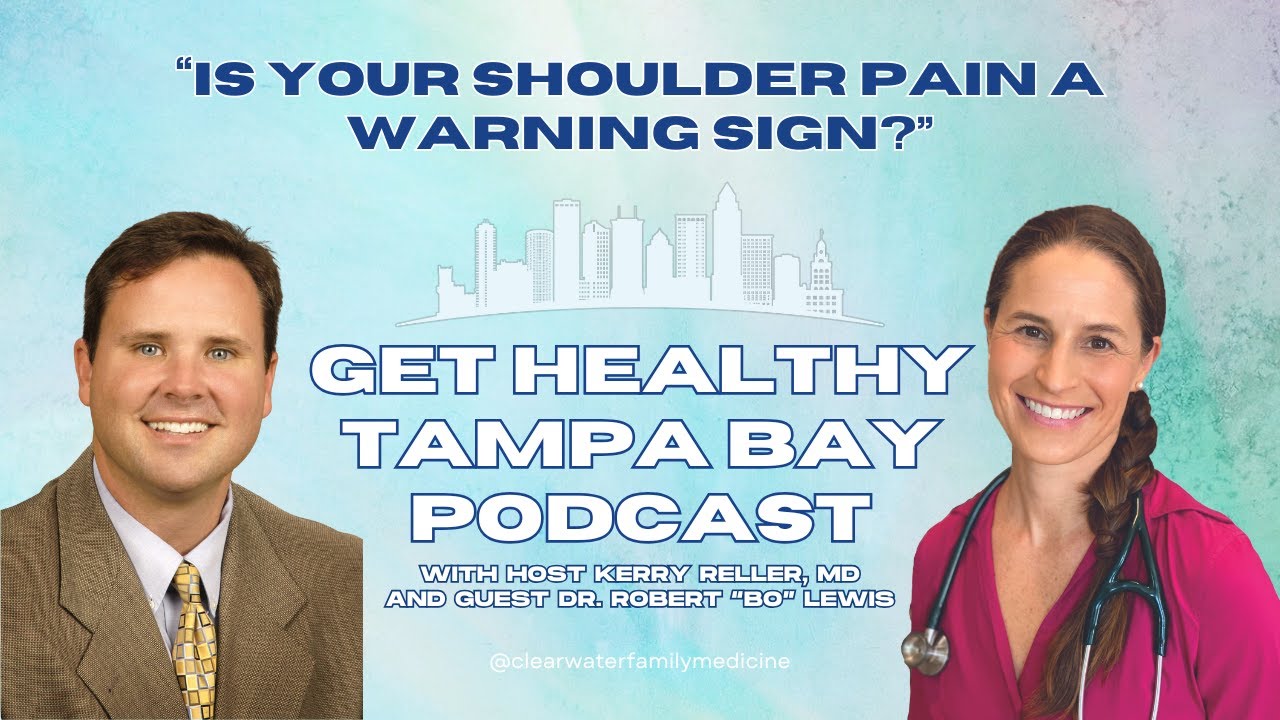
Dr. Robert “Bo” Lewis on Shoulder Pain, Rotator Cuff, Labral Tears & Frozen Shoulder
Almost everyone experiences shoulder pain at some point, and the shoulder is one of the trickiest joints to diagnose. In this episode of the Get Healthy Tampa Bay Podcast, Dr. Kerry Reller talks with Dr. Robert "Bo" Lewis, a fellowship-trained orthopedic surgeon and founder of Coastal Shoulder in the Tampa Bay area, about common shoulder problems at every age, from young athletes to older adults, and when you may need to see a specialist.
Why Shoulders Hurt So Often
Dr. Lewis explains that the shoulder has more range of motion than any other joint. While the hip is a deep ball and socket built for stability, the shoulder works more like a golf ball sitting on a golf tee, held in place by ligaments and the rotator cuff muscles. We also position our hands with our shoulders all day long, from reaching into cabinets to hanging up towels. And the rotator cuff lives in a very tight space, so any swelling or wear can lead to pinching, tendon problems and bursitis.
Shoulder Problems in Young Athletes
In children and teens whose growth plates are still open, the growth plate is the weakest link. Repetitive throwing can inflame it, causing conditions known as Little League shoulder or Little League elbow. That is why youth pitch count limits matter. As muscles fatigue, more stress shifts onto bones, growth plates and ligaments. Older teens and young adults whose bones have finished growing are more likely to develop instability and labral tears, including SLAP tears at the top of the socket, especially in throwers, swimmers, volleyball players and contact sports athletes. Some looseness helps athletes perform, but painful looseness, called instability, needs attention.
Rotator Cuff Problems in Your 40s and 50s
As we age, rotator cuff tendons gradually wear, much like the tread on a tire. Blood supply decreases and the tendon becomes less organized, a condition called tendinosis. When daily wear outpaces repair, people develop a dull, toothache-like pain in the upper arm that often wakes them at night. Shoulder impingement happens when the tendon gets pinched between the bones as you lift your arm, especially when reaching overhead or into the back seat of the car. Some people are born with a bone shape that makes impingement more likely.
Key Takeaways
Night pain in the upper arm: A dull ache between the shoulder and elbow that wakes you up is most often a rotator cuff issue.
Most partial tears improve without surgery: Dr. Lewis says about 7 out of 10 people with partial rotator cuff tears get better with physical therapy, sometimes with an injection, and time.
Pain only with activity: This may point to a labral tear or biceps tendon problem, especially in active adults.
Stiffness with grinding: Restricted motion with crunching may signal shoulder arthritis.
A full-thickness tear does not always cause pain: Many older adults have full rotator cuff tears and still function well.
Diagnosis starts with a good physical exam: Specialized shoulder tests are designed to reproduce the pain and identify its source.
Frozen Shoulder
Frozen shoulder, or adhesive capsulitis, happens when the lining of the shoulder joint becomes inflamed, thick and tight, causing painful loss of motion in every direction. Many women first notice it when they can no longer reach behind their back to fasten a bra. It most commonly affects postmenopausal women and also occurs more often in people with diabetes. It progresses through freezing, frozen and thawing phases and can last about 18 months if untreated. Dr. Lewis notes that research has repeatedly shown frozen shoulder usually resolves on its own, but physical therapy, anti-inflammatory medication and a steroid injection during the painful freezing phase can shorten recovery to about six to nine months. Surgery is rarely needed.
Treatment for Older Adults
If a rotator cuff tear grows very large and the muscles waste away, some people lose the ability to lift their arm. Options may include special repairs, grafts or a reverse shoulder replacement. In a standard shoulder replacement, the ball and socket are replaced in their usual positions, which requires a working rotator cuff. A reverse shoulder replacement swaps the ball and socket, allowing the large deltoid muscle to lift the arm when the rotator cuff can no longer do its job. Arthroscopic surgery uses small incisions and tiny instruments, which preserves the deltoid muscle and supports recovery.
Conclusion
Shoulder pain is common, but most cases improve with the right diagnosis, physical therapy and time. Pay attention to night pain, loss of motion, weakness or pain that limits your daily activities, and do not wait years to get it checked. If you live in the Tampa Bay area and are dealing with shoulder pain, Clearwater Family Medicine and Allergy can help evaluate it and connect you with the right next steps. Call (727) 446-1097 or visit cfma.health.
About Our Guest
Dr. Robert G. “Bo” Lewis is the founder of Coastal Shoulder Surgery & Sports Medicine and has specialized in shoulder surgery since 2006. A board-certified, fellowship-trained orthopedic surgeon, Dr. Lewis focuses on arthroscopic shoulder procedures and sports medicine. Before medicine, he earned a business degree in risk management from the University of Georgia and worked in Tampa before completing his medical degree at the University of South Florida. He went on to complete his orthopedic residency at the Medical College of Georgia and a fellowship in shoulder surgery at McCluskey Orthopaedic Surgery.
Dr. Lewis has performed more than 10,000 arthroscopic procedures, with expertise in rotator cuff and labral repairs, biceps tenodesis, and superior capsular reconstructions. He and his team pioneered a technique for performing shoulder surgery without general anesthesia. His practice also treats sports-related injuries of the elbow, hip, and knee, including ACL reconstructions and Tommy John procedures. Dr. Lewis is a Fellow of the American Academy of Orthopaedic Surgeons and an active member of the Arthroscopy Association of North America, Southern Orthopaedic Association, Florida Orthopaedic Society, and Florida Medical Association.
Connect with Dr. Bo Lewis
Listen to the full episode on the Get Healthy Tampa Bay Podcast: Dr. Robert “Bo” Lewis on Shoulder Pain, Rotator Cuff, Labral Tears & Frozen Shoulder.
Listen and Learn More
Watch the full episode above or listen to the Get Healthy Tampa Bay Podcast on your favorite podcast app. To schedule a visit with Dr. Kerry Reller at Clearwater Family Medicine and Allergy in Clearwater or Palm Harbor, call (727) 446-1097.


