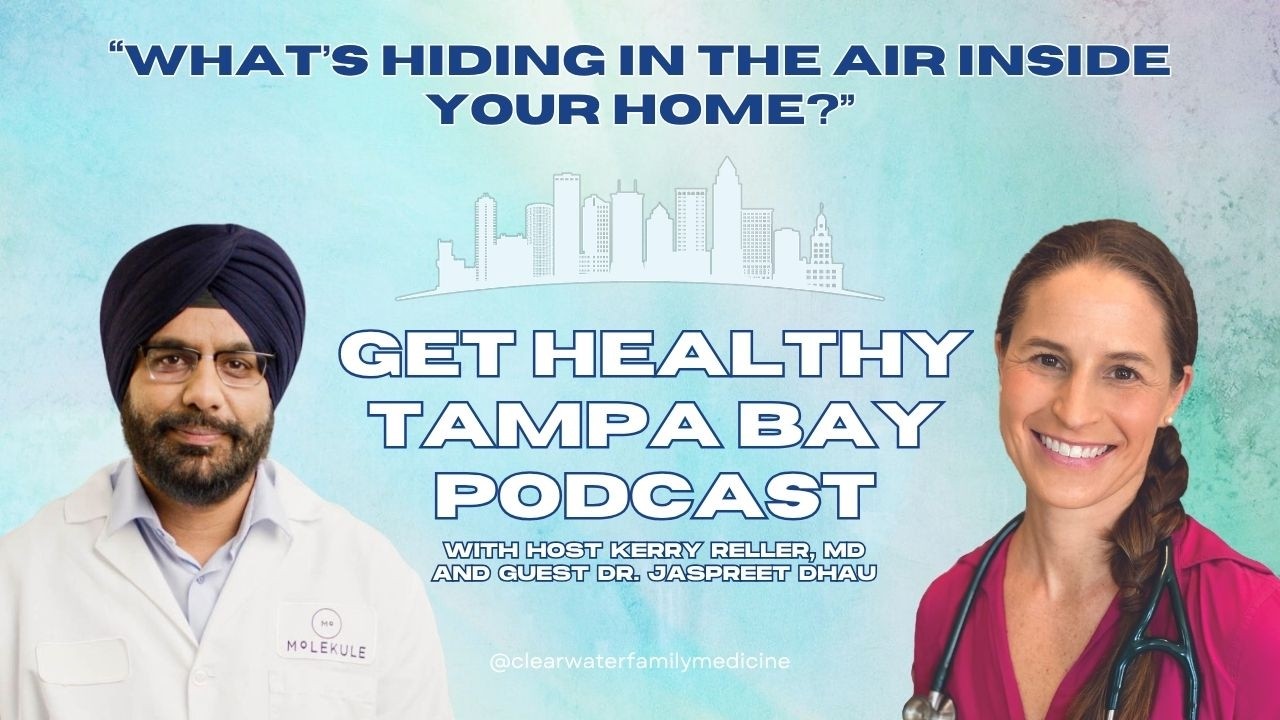
Dr. Jaspreet Dhau on Indoor Air Quality, Allergies, Mold, Sleep and Better Health
We pay close attention to the water we drink and the food we eat, but how often do we think about the air inside our homes? In Part 1 of this conversation on the Get Healthy Tampa Bay Podcast, Dr. Kerry Reller talks with Dr. Jaspreet Dhau, a PhD chemist and Vice President of Research and Development at Molekule, about what is really in our indoor air and how it affects allergies, asthma, sleep and long-term health.
A Father's Motivation
Dr. Dhau has spent more than 20 years developing eco-friendly products in academia and industry, with over 20 patents. Air quality became personal for him when his young son developed allergy and asthma symptoms while the family lived in India, which was one reason they moved to the United States. Later, his son, a talented cricketer who represented Florida, had to step away from the sport because his allergies became so severe. That experience pushed Dr. Dhau to focus his research on indoor air.
We Spend Almost Our Whole Lives Indoors
Dr. Dhau shares a striking statistic often called the "Corsi code": of an average U.S. life expectancy of about 79 years, roughly 69 years are spent indoors and only about six years outdoors. The World Health Organization links millions of premature deaths each year to air pollution, a large share of them to indoor air pollution. Poor indoor air has been connected not just to allergies and asthma, but also to heart disease, strokes, lung damage and lung cancer.
What Is in Your Indoor Air?
Particulate matter (PM2.5 and PM10): Tiny particles that come in from outside and are created indoors by cooking, showers, carpets, vacuuming without a HEPA filter, smoking, candles and air fresheners. The smallest particles reach deep into the lungs.
Volatile organic compounds (VOCs): Chemicals released by new furniture, carpets, paint, cooking and combustion. Formaldehyde is a common one and is both an irritant and a carcinogen. Grilling can produce cancer-causing polycyclic aromatic hydrocarbons.
Inorganic gases: Such as nitrogen dioxide from gas cooking and unventilated fireplaces.
Biological contaminants: Bacteria, viruses and mold, plus mycotoxins released by mold and broken mold fragments that trigger allergies and asthma.
Four Steps to Better Indoor Air
1. Source control: Remove what creates pollution. Never smoke indoors, and cut back on candles and spray fragrances.
2. Ventilation: Use a vented range hood that sends cooking fumes outside, and open windows when outdoor air quality and pollen counts are good, sometimes called "house burping." Check pollen and air quality before you open up.
3. Air cleaning: Use a good filter in your central air system, plus a portable air purifier where you spend the most time.
4. Temperature and humidity control: Keeping humidity in check prevents mold and other microorganisms from growing.
Key Takeaways
Upgrade your HVAC filter: Look for a MERV 11 filter, or MERV 13 if your system allows, especially during pollen season or if you have young children, older adults or anyone with allergies or asthma at home.
Put a purifier in your bedroom: Turning over in bed stirs up particles from pillows and mattresses, so a purifier near your bed targets the air you breathe while you sleep.
Look for true HEPA: A real HEPA filter captures 99.97% of particles 0.3 microns and larger. Products labeled "HEPA-like" or "HEPA-type" may not meet that standard. Standard HEPA filters capture particles but not VOCs.
Carbon filters have limits: Activated carbon absorbs VOCs but can become saturated and need replacing.
Indoor Air and Sleep
Research links indoor pollutants to shorter sleep, poorer sleep quality and changes in every stage of sleep. Studies have tied nitrogen dioxide and formaldehyde exposure to sleep apnea, and fine particles to changes in REM sleep. Dr. Reller notes that improving indoor air may help many people with sleep, brain fog and next-day fatigue, not just those with allergies, and may help patients with sleep apnea who struggle to use CPAP because of nasal allergies.
How Molekule's Technology Works
Dr. Dhau explains that Molekule purifiers combine a true HEPA filter with what the company calls PECO technology. A light-activated coating on the filter creates hydroxyl radicals, the same molecules that help clean the atmosphere, right on the filter surface. These break down VOCs into carbon dioxide and water and destroy captured mold, bacteria and viruses, so they are not released back into the air.
Conclusion
Since we spend about 90% of our time indoors, improving the air at home is one of the most practical steps you can take for your health. Start with source control and ventilation, upgrade your HVAC filter and add a true HEPA purifier in your bedroom. In Part 2, Dr. Dhau shares more practical steps for choosing purifiers and protecting your family. If allergies or asthma are affecting your sleep or daily life, the allergy team at Clearwater Family Medicine and Allergy can help identify your triggers. Call (727) 446-1097 or visit cfma.health.
Clearwater Family Medicine and Allergy has cared for allergy, asthma and immunology patients in the Tampa Bay area since 1979, when Dr. Reller's father, allergist and immunologist Dr. J. Wayne Phillips, founded the practice.
About Our Guest
His academic achievements are equally impressive. He is a recipient of the Pran Nath Vohra Research and Entrepreneurship award and the Distinguished Alumnus award from Panjab University. The National Academy of Inventors has recognized him as one of the top emerging inventors of 2022, and he has been inducted as a Senior Member of the Academy.
Dr. Dhau's research interests are diverse and impactful, encompassing indoor air purification, photocatalysis, organochalcogen chemistry, fluorine-free chemistry for fire suppression, corrosion protection, and additive manufacturing. He has mentored numerous Ph.D. students and research scholars, guiding them through their academic journeys.
With over 30 patent applications filed, including 20 granted patents in the U.S. and other countries, and over 65 peer-reviewed publications, Dr. Dhau's research has been widely recognized and cited. He has secured over $6 million in grants from various State and Federal agencies.
Recently, Dr. Dhau has been at the forefront of groundbreaking research, evaluating the impact of air purification on allergies/asthma and clinical recovery in mild or moderate COVID patients.
Listen to the full episode on the Get Healthy Tampa Bay Podcast: Dr. Jaspreet Dhau on Indoor Air Quality, Allergies, Mold, Sleep and Better Health
Listen and Learn More
Watch the full episode above or listen to the Get Healthy Tampa Bay Podcast on your favorite podcast app. To schedule a visit with Dr. Kerry Reller at Clearwater Family Medicine and Allergy in Clearwater or Palm Harbor, call (727) 446-1097.


