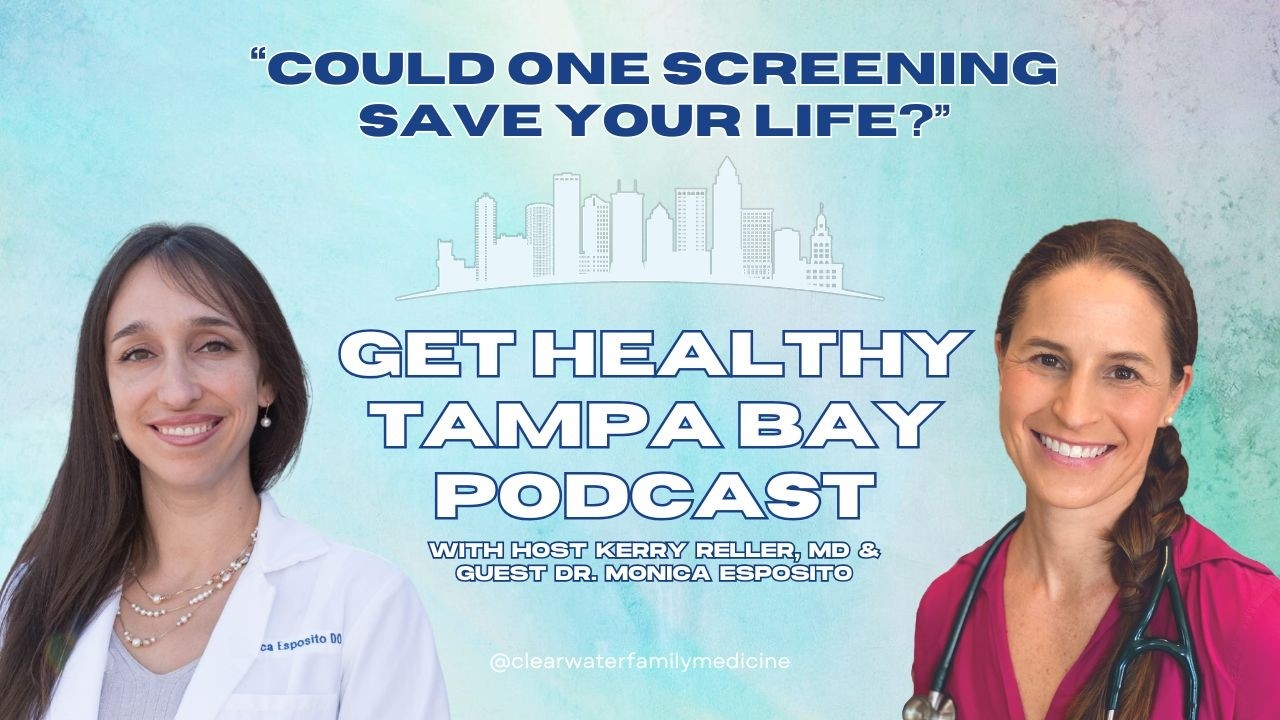
Cancer Prevention & Screening Guidelines with Dr. Monica Esposito
Many serious diseases are highly treatable when they are caught early, often before you have any symptoms at all. In Part 2 of her conversation with Dr. Kerry Reller on the Get Healthy Tampa Bay Podcast, Dr. Monica Esposito, founder of Ascend Concierge Medicine in North Tampa, walks through the screenings that matter most, from lung and colon cancer to bone density, and the ones that are often missed.
Why Screening Matters
In primary care, cancers caught early are usually found one of two ways: by accident on a scan done for another reason, or through routine screening. When someone comes in because a cancer is causing symptoms, it is often already stage III or IV. Screening gives you the chance to find problems while they are still small and much easier to treat.
Screenings You Should Know About
Abdominal aortic aneurysm (AAA): A one-time ultrasound checks for a weak, ballooning section of the body's main artery, which can tear and bleed. Guidelines recommend it for men ages 65 to 75 who have ever smoked, and even smoking for a short time as a teenager counts. Dr. Esposito also considers it for patients with high blood pressure.
Lung cancer: A yearly low-dose CT scan is recommended starting at age 50 for people with at least a 20 pack-year smoking history who still smoke or quit within the past 15 years. One pack a day for 20 years, or half a pack a day for 40 years, both equal 20 pack-years. Dr. Esposito has caught several early cancers this way.
Colon cancer: Screening now starts at age 45 for average-risk adults because colorectal cancer is rising in younger people. Earlier screening is needed for people with a strong family history or conditions like Lynch syndrome.
Breast cancer: Guidelines from different organizations disagree on whether to screen every year or every two years. Both doctors prefer yearly mammograms starting at 40, having seen patients diagnosed after missing just one year. Women with dense or fibrocystic breasts may also need an ultrasound, and high-risk women may need MRI in addition to mammograms. Thermography is not a substitute.
Bone density (DEXA): Routine screening officially starts at 65 for women, which both doctors feel is too late to prevent bone loss with lifestyle changes. Earlier scans may be covered for menopause, malabsorption, gastric bypass or a recent fracture. Some DEXA scans can also measure body composition.
Liver cancer: People with cirrhosis, including those who were cured of hepatitis C but still have liver scarring, need regular liver ultrasounds because their cancer risk remains high.
Eyes and hearing: Routine eye exams can catch glaucoma, diabetic eye disease and even eye melanoma. Hearing loss is a modifiable risk factor for dementia, so get your hearing checked.
Choosing a Colon Cancer Test
Dr. Esposito recommends colonoscopy for almost everyone because it is the gold standard. It finds and removes polyps (precancerous growths) during the same procedure, and a clear result usually means you do not need another for 10 years. Other options include yearly stool tests (FIT or FOBT), Cologuard every three years, sigmoidoscopy and a newer blood test called Shield. The blood test is better at detecting cancer than polyps, and it is only for average-risk adults who refuse other options. As she puts it, doing something is better than nothing, but colonoscopy comes first.
Tips for a Better Colonoscopy
Follow the prep fully: The bowel prep is often the hardest part, but a poor prep means the doctor cannot see everything and you may need to repeat the test sooner.
Expect a pre-visit: Seeing the gastroenterologist first helps tailor the prep, such as for people with constipation, and allows them to plan an upper endoscopy at the same time if needed.
Ask about cash pricing: For patients without insurance, cash-pay colonoscopies including anesthesia and biopsies may be more affordable than expected.
Newer Tests: Blood Tests and Full-Body MRI
Multi-cancer blood tests such as Galleri and Cancerguard look for signs of many cancers in the blood. They are meant to add to, not replace, standard screenings. They may be most useful for higher-risk people and for cancers with no routine screening test, such as ovarian and pancreatic cancer. Genetic testing for conditions like BRCA mutations or Lynch syndrome can also identify people who need earlier or more frequent screening. Full-body MRI can find problems, but it is costly and often turns up harmless "incidentalomas" that cause worry, so Dr. Esposito prefers targeted imaging when there is a specific concern.
Key Takeaways
Screening finds many cancers early, when they are most treatable
Know which screenings are recommended for your age and risk
Several colon cancer tests exist, and colonoscopy can find and remove polyps
Newer blood tests and full-body MRI do not replace standard screening
Conclusion
Prevention is one of the most powerful tools in medicine. Know which screenings you are due for based on your age, family history and lifestyle, and if your doctor is not bringing them up, advocate for yourself and ask. The goal is to find problems early, when they are most treatable, and to help you live your healthiest, longest life.
About Our Guest
Dr. Monica Esposito is a Board Certified Family Medicine Physician and the Founder of Ascend Concierge Medicine in North Tampa. Her practice is centered around providing comprehensive primary care with an elevated patient experience. She strongly emphasizes preventative medicine and aims to optimize health, longevity and quality of life. Members of Ascend can enjoy extended appointments, easy access to their personal physician, and numerous procedures all included under their annual fee.
Ascend Concierge Medicine is conveniently located on North Florida Avenue between Lake Magdalene and Bearss just 2 minutes from I-275.
Connect with Dr. Monica Esposito
Listen to the full episode on the Get Healthy Tampa Bay Podcast: Cancer Prevention & Screening Guidelines with Dr. Monica Esposito
Listen and Learn More
Watch the full episode above or listen to the Get Healthy Tampa Bay Podcast on your favorite podcast app. To schedule a visit with Dr. Kerry Reller at Clearwater Family Medicine and Allergy in Clearwater or Palm Harbor, call (727) 446-1097.


